




















 Back
Back

Complete List of Government Bonds in India (2026): Your Guide to Sovereign Safety
In the volatile financial landscape of 2026, where global markets are shifting and the RBI Repo Rate stands at 5.25%, the search for "absolute safety" has led millions of Indian investors back to sovereign debt. Government Bonds, or G-Secs, are no longer just for institutional giants; they are now a staple for retail portfolios, offering a unique blend of zero default risk and competitive yields.
Whether you are looking for short-term liquidity through Treasury Bills or long-term retirement planning via Dated Securities, this comprehensive list of government bonds in India will help you navigate the 2026 debt market with confidence.
The 2026 Outlook: Why Government Bonds Now?
As of March 2026, the Indian 10-year G-Sec yield is hovering around 6.66%. In an era where bank FDs often struggle to provide a significant spread over inflation, government securities offer a "Sovereign Guarantee," meaning the principal and interest are backed by the Government of India.
With the RBI Retail Direct portal and platforms like Stashfin simplifying access, retail participation in these bonds has hit an all-time high.
Comprehensive List of Government Bonds in India (2026)
The Indian government issues various types of debt instruments to meet different duration and cash-flow needs. Here is the definitive list:
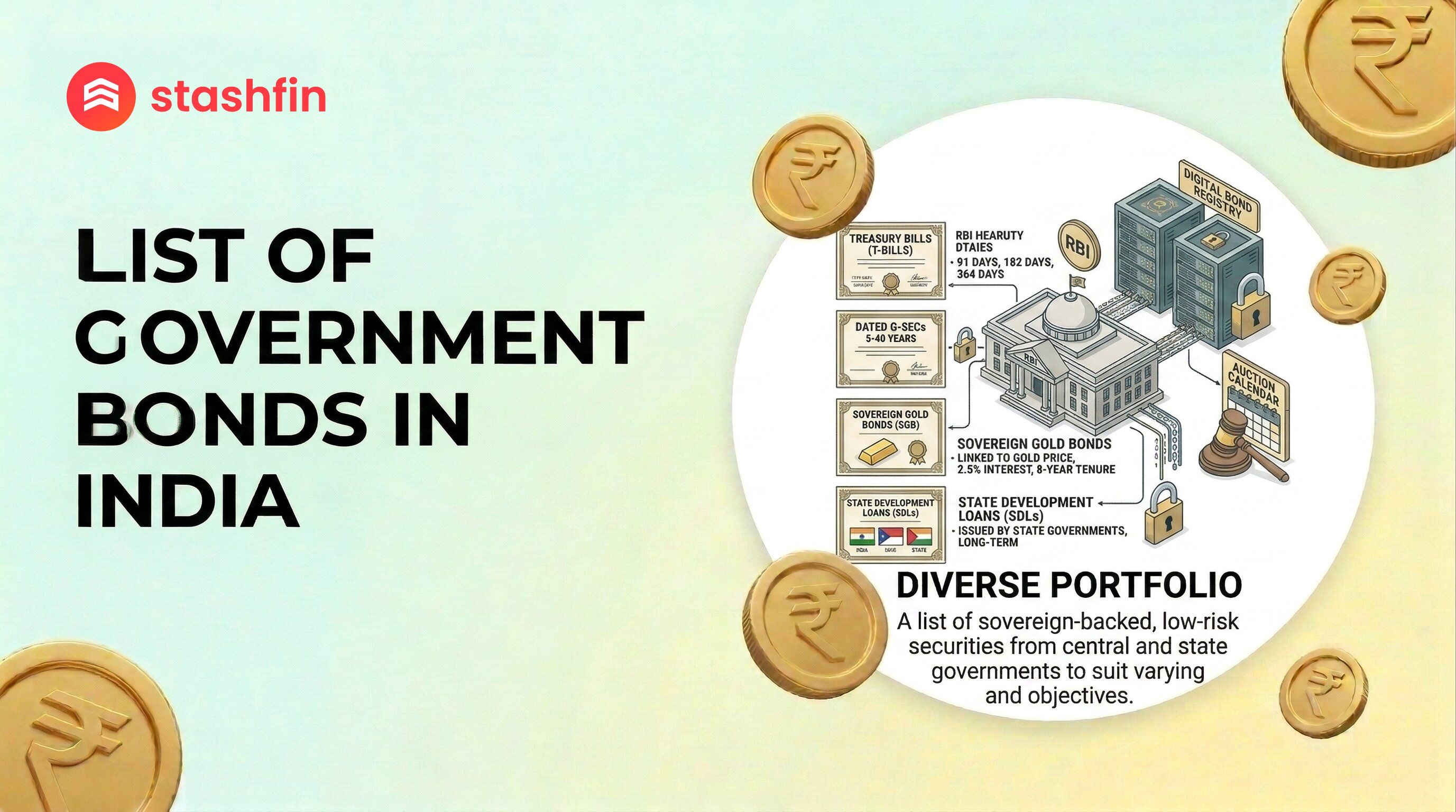
A. Treasury Bills (T-Bills) - Short Term
T-Bills are zero-coupon securities used for short-term cash management. They are issued at a discount and redeemed at face value.
| Type | Tenure | Current Indicative Yield (Mar 2026) |
|---|---|---|
| 91-Day T-Bill | 3 Months | 5.30% |
| 182-Day T-Bill | 6 Months | 5.52% |
| 364-Day T-Bill | 1 Year | 5.62% |
B. Dated Government Securities (G-Secs) - Long Term
These are the most popular "bonds," paying fixed interest (coupons) semi-annually.
- 5-Year G-Sec: Currently yielding approx 6.33%.
- 10-Year G-Sec (Benchmark): Currently yielding 6.66%.
- 30-Year/40-Year G-Sec: Yields reach up to 7.40%, ideal for long-term pension planning.
C. Floating Rate Savings Bonds (FRSB) 2020 (Taxable)
Commonly known as "RBI Floating Rate Bonds," these are a favorite for 2026 investors because their rates reset every six months.
- Current Interest Rate: 8.05% (Valid until June 30, 2026).
- Formula: NSC Rate + 0.35%.
- Tenure: 7 Years.
D. State Development Loans (SDLs)
Issued by state governments (like Maharashtra, Karnataka, or Uttar Pradesh) to fund local infrastructure.
- Yield Advantage: SDLs typically offer a spread of 25–50 basis points over Central Government bonds.
- Current Yields: Ranging between 7.40% and 7.60% depending on the state's fiscal health.
E. Sovereign Gold Bonds (SGBs)
These bonds allow you to invest in gold without the hassle of physical storage.
- Fixed Interest: 2.50% p.a. on the initial investment.
- Capital Gains: Linked to the market price of gold (tax-free if held until maturity).
- Note: As per Budget 2026, tax exemptions are strictly for original subscribers who hold until the 8-year maturity.
Comparison: Government Bonds vs. High-Yield Corporate Bonds
Many 2026 investors use a Barbell Strategy—combining G-Secs with high-yield corporate bonds to boost overall returns.
| Feature | Central Govt Bonds (G-Sec) | Akara Capital Bonds (Stashfin) |
|---|---|---|
| Issuer | Government of India | Akara Capital (NBFC) |
| Risk | Zero Default Risk | Moderate (Credit Rated BBB) |
| Annual Yield | 6.5% – 7.4% | 14.5% |
| Payout | Semi-Annual | Monthly |
| Liquidity | High (Secondary Market) | Moderate (Short Tenure) |
How to Invest and Tax Treatment (2026)
How to Buy:
- RBI Retail Direct: The official portal (rbiretaildirect.org.in) allows for free bidding in primary auctions.
- Stock Brokers: Buy G-Secs and T-Bills directly via your Demat account on NSE/BSE.
- Secondary Market: For example, the 6.68 GS 2040 is currently trading at approx ₹96.54 with a yield of 7.07%.
Tax Rules:
- Interest Income: Taxable as per your individual income tax slab.
- Capital Gains: If sold after 1 year in the secondary market, gains are taxed at 12.5% (as per 2026 rules).
- SGB Exception: Redemption at maturity remains tax-exempt for original individual subscribers.
Conclusion
The list of government bonds in India for 2026 offers something for every risk appetite. From the liquidity of T-Bills to the inflation-beating potential of FRSBs (8.05%), these instruments are the bedrock of a stable portfolio. By pairing these secure bonds with the 14.5% yields of Akara Capital Bonds, you can ensure your money is both safe and growing at an optimal pace.

